
EAV Technology
Broadcast - Products - Intraplex
Intraplex NetXpress IP/T1/E1 Multiplexer
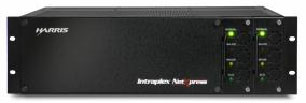
The Intraplex® NetXpress™ IP/T1/E1 multiplexer takes voice and data transport to a new level of performance and reliability. It provides transport over packet networks for a wide range of real-time applications critical to public safety. As the industry’s best platform for public safety systems requiring transport over IP, NetXpress™ offers system-level resiliency, sophisticated network monitoring and excellent bandwidth management. NetXpress™ delivers the quality of Intraplex® and the economy of IP in one solution.
NetXpress™ is a superior solution for public safety applications such as land mobile radio systems, video surveillance, monitoring of remote sites and emergency backup of circuits.
- Voice, data, and video transport over IP networks
- Multiple service transport in one or more streams
- Simulcasting over IP with SynchroCast3™
- Smooth migration to packet-switched networks
- Built-in forward error correction (FEC), packet delay jitter compensation and low-delay packet processing
- Ability to use existing communications infrastructures
- Simultaneous IP & T1/E1 operation
- Browser-based graphical user interface
- SNMP interface for connection to network management systems
| General The base system includes the chassis with one Network Interface Module (NIM), one Module Interface Unit (MIU), and one power supply. Hot-standby redundant NIM and power supply optional. | |
| Module Compatibility Accepts Intraplex plug-in audio, voice, data and video modules. See individual module specifications for details and applications. | |
| Voice Support | 2 Wire FXO, FXS, E&M 4 Wire E&M, TO Automatic Ring-Down (ARD) Off-Premise extensions (OPX) |
| Data Support | Synchronous and asynchronous serial data Rate-adaptive synchronous data Partitioned Ethernet capacity RS-232, RS-449, V.35, X.21, and more |
| Ethernet Data Rate (WAN, LAN and MGMT ports) | 10/100BASE-T (10 or 100 Mb/s) Full duplex Auto-negotiation with network |
| Ethernet Connector | Port 1 – Management LAN- RJ-45 Port 2 – WAN- RJ-45 Port 3 – LAN- RJ-45 |
| T1/E1 Data Rate | T1: 1.544 Mb/s E1: 2.048 Mb/s |
| T1/E1 Connector | Two – RJ-45 |
| Payload Bandwidth | Four TDM Busses delivering up to 8 Mb/s (E1 Mode) or 6 Mb/s (T1 Mode) Packet Bus delivering additional bandwidth based on selection of Channel Access Modules |
| Circuit Connection | Up to 32 streams/connections Point-to-point unidirectional Point-to-point bidirectional Point-to-multipoint unidirectional Multicast (IGMP v2) |
| Network Protocols | IP, TCP, UDP, RTP, DHCP, DNS, HTTP, FTP, Telnet, NTP, SNMP v2c, RTCP, ARP, ICMP |
| Timing | Internal External, RS-422 clock input Adaptive to incoming program stream Timing out, RS-422 clock output |
| Forward Error Correction (Per Stream) | High, Low, Off, User-selectable |
| Packet Optimization (Per Stream) | Programmable jitter buffer depth to 128 packets (Provides compensation in excess of 1 sec of network jitter) |
| Quality Of Service (Per Stream) | Adjustable packet size/rate IPv4 Type of Service tagging Differentiated Service (DiffServ) |
| LED Indicators | Normal, Major Alarm, Minor Alert, Alarm Cutoff (ACO), LAN Link Status, LAN 100 MB, LAN Activity, External Timing, Internal Timing, Adaptive Timing, Network Status |
| Alarm Reporting | Major/minor alarms NO/NC relay contacts SNMP traps, user-configurable Alarm logs Off-site server storage for log files |
| Network Performance Statistics (Per Stream) | Packet Loss, packets received, packets sent, packets dropped, packet count, and delay variation |
| Loopbacks | Received stream loopback, Equipment loopback |
| Remote Management | Web browser user interface SNMP Network Management interface |
| Power Requirements | Universal AC 90-240 V AC, 50/60 Hz, 48 V DC or 24 V DC |
| Power Supply | Single or redundant 80 W AC 200 W AC 150 W 48 V DC 150 W 24 V DC DC supplies can use either positive or negative ground reference |
| Power Supply Alarm Contact rating | 50 V DC, 100 mA |
| Power Consumption | 15 W or less with no channel modules installed |
| Environmental | Temperature: 0° – 50° C (32° – 122° F) operating (AC powered) Humidity: 10% - 90% non-condensing |
| Physical | 3RU – 5.25 in. (13.4 cm) H x 14.25 in. (36.2 cm) D x 19 in. (48.3 cm) W Weight: 11 lb. (5 kg) approximate, w/o channel modules installed; Max weight depends on number and type of modules installed. |
| Regulatory Compliance | CE Compliant, FCC Part 15 Class A, UL 1950, RoHS Compliant |